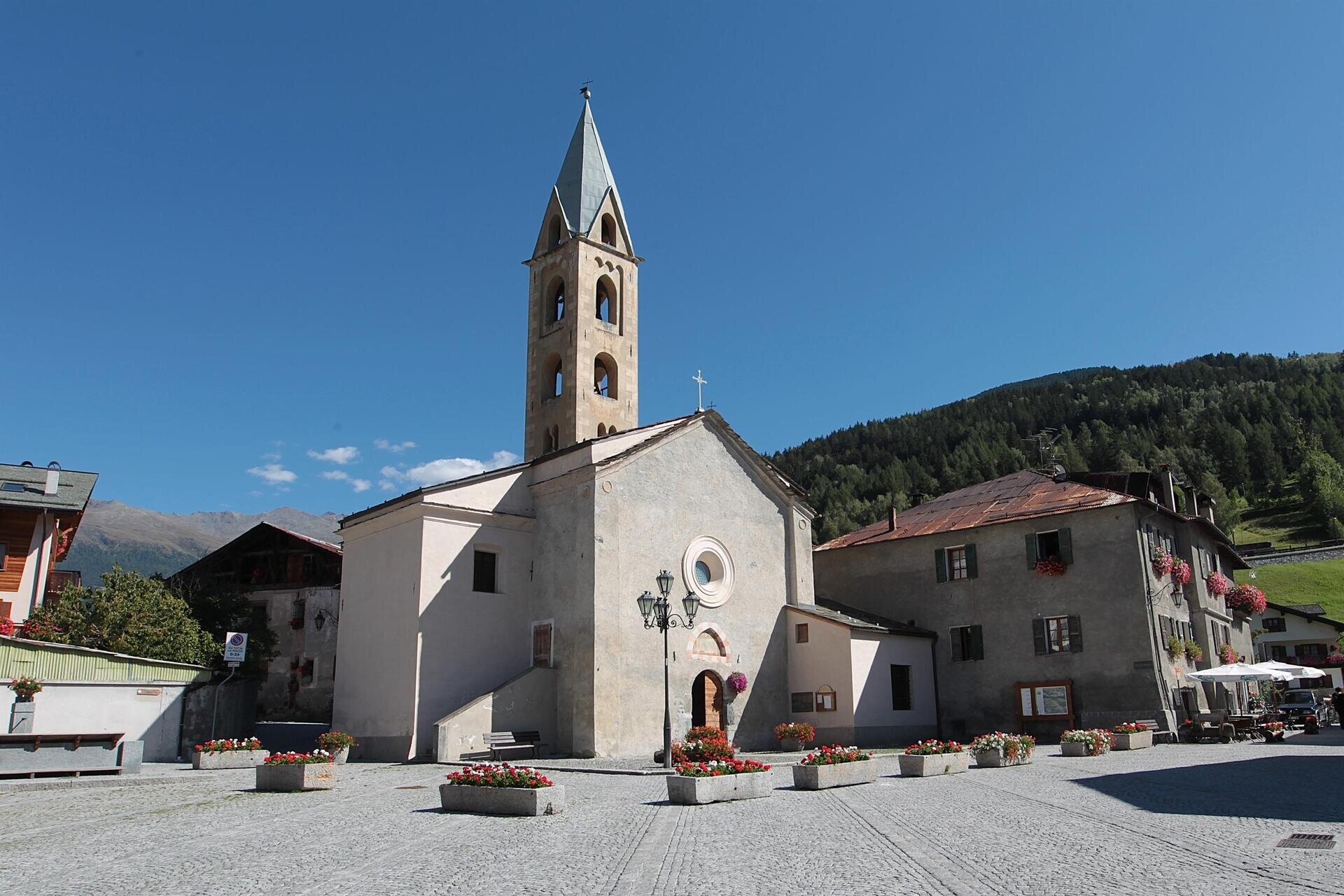
Built in 1356 as a vow following the plague, the Church was dedicated to St. Anthony the Abbot, protector of animals. Today it is primarily known as the Church of the Holy Crucifix, in honor of the wooden crucifix found inside. The building has been modified several times over the centuries and, in the 16th century, was raised with the renovation of the side walls.
Exterior
The exterior of the church is simple and linear, with a gabled roof, a simple rose window, and the fresco of Imago Pietatis by an unknown author. On the outer part of the apse, framed in a niche, there is an image of St. Anthony the Abbot, overshadowed by the figure of God the Father Blessing holding the terrestrial globe with a cross in his left hand. Also noteworthy is the painted scroll in the attic. In 1737, a side chapel was added, intended to house the Crucifix, and the bell tower in Lombard style was constructed.
Interior
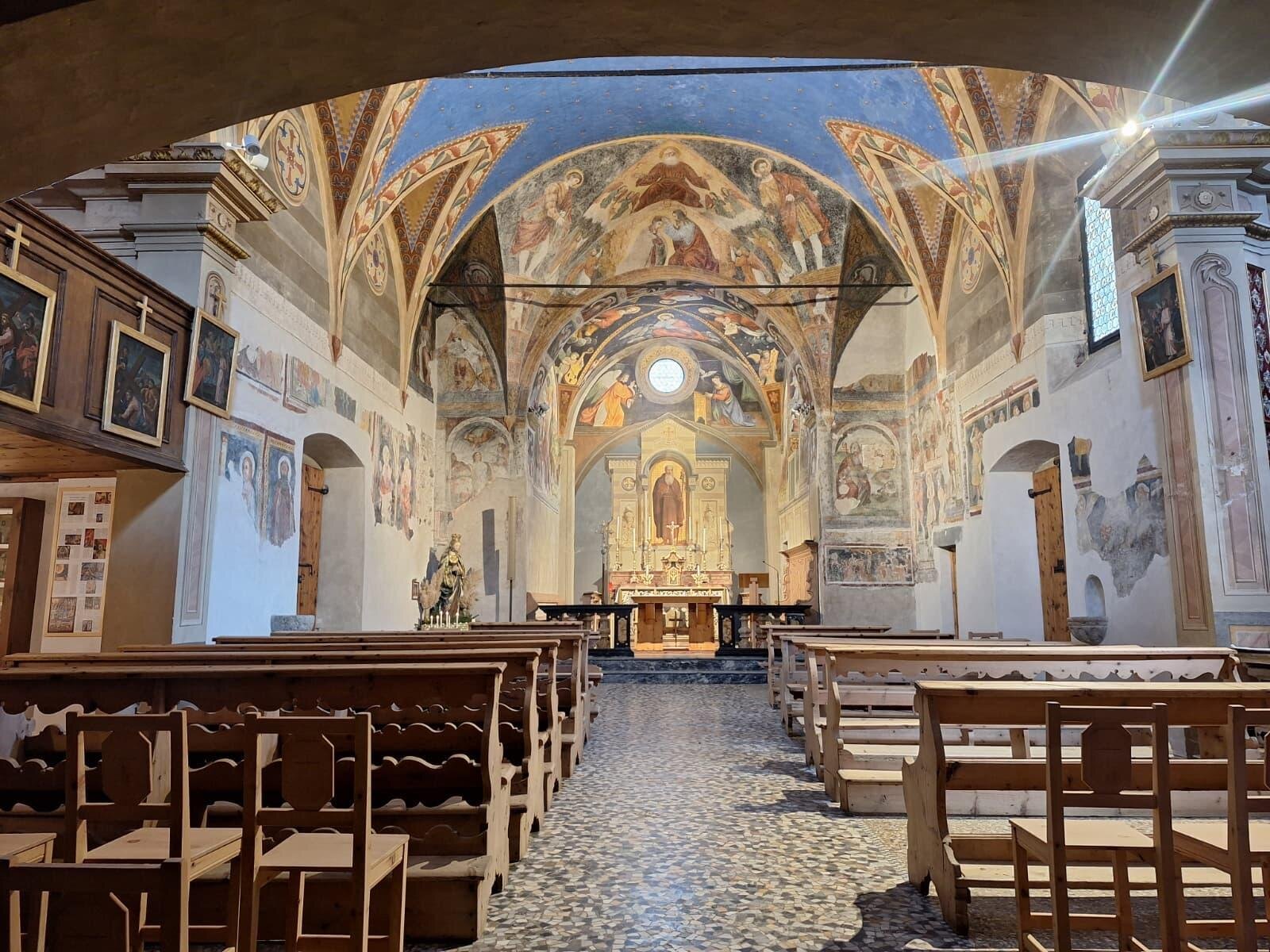
The small sanctuary is characterized by the significant amount of frescoes, although it has been modified several times over the centuries. While the starry sky decoration is more recent, among the oldest representations, on the right side, the scenes of the Passion of Christ (dating back to 1368) appear. Over part of this fresco, particularly elegant images of the Visit of the Magi are noticeable. At the base of the triumphal arch, there is a Crucifixion, dated to 1376, which is decidedly dramatic and intense.
On the left wall are several precious scenes, among which can be distinguished St. Anthony the Abbot (1472) with the typical bell and other saints along with a few details of a noteworthy Crucifixion with the figures of Mary Magdalene and St. John. Very unique are the votive tablets (18th-20th centuries) that have been donated by the faithful over the centuries for favors received.
The triumphal arch features, on the right, the famous scene of St. Augustine (with the child wanting to empty the sea with a spoon) and, on the left, the martyrdom of St. Catherine, both overshadowed by the portraits of the Church Fathers and the Prophets.
The presbytery, from the 16th century, depicts episodes from the life of St. Anthony the Abbot, interspersed with floral and decorative motifs, grotesque figures, and musical angels. On the subarch appear the Prophets while, on the back wall, the Annunciation, and on the ceiling, the Evangelists. At the apex of the triumphal arch, the image of God the Father and the image of the Coronation of the Virgin flanked by Saints Gervasius and Protasio, patrons of Bormio.
Crucifix
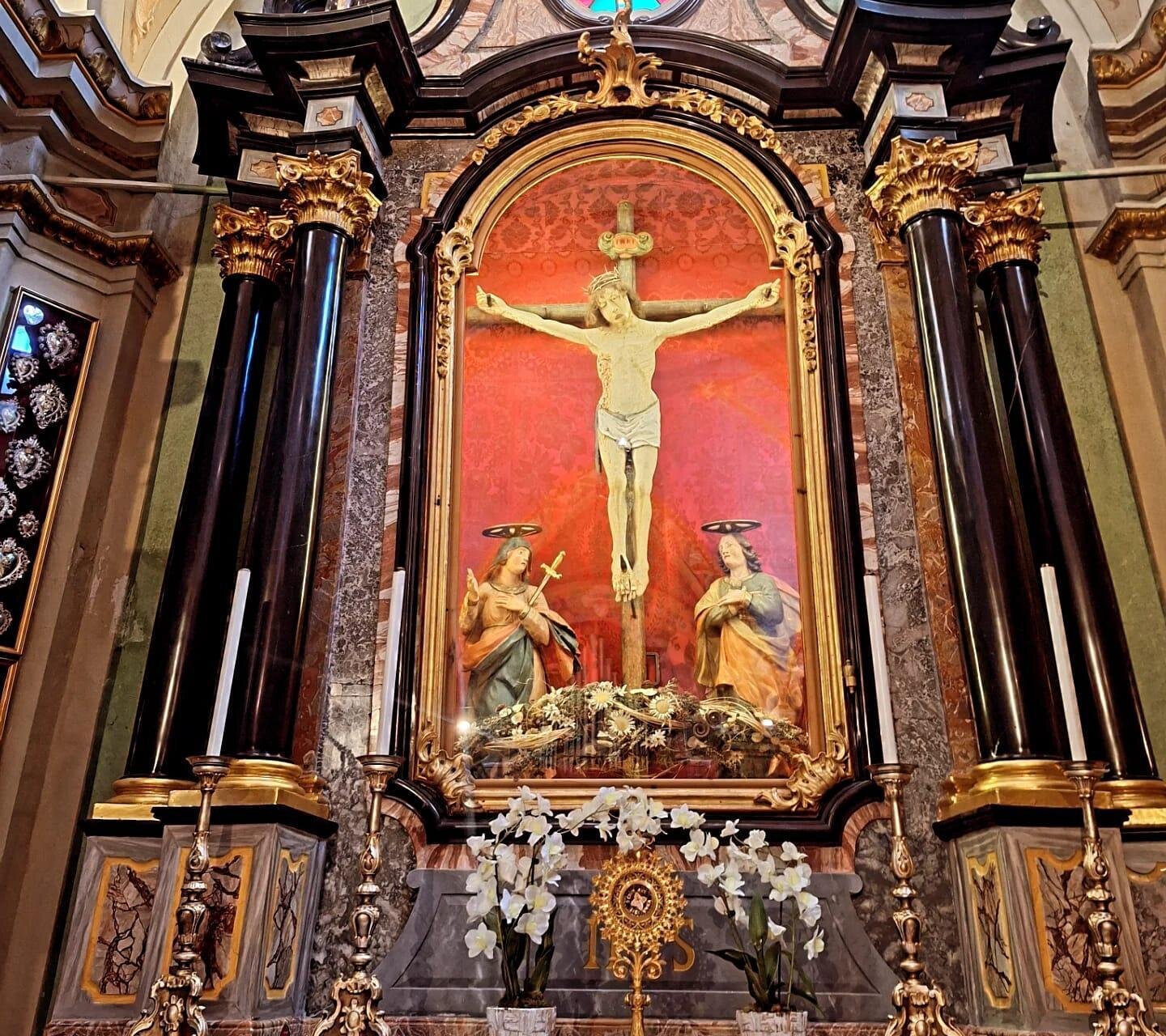
Wooden cross carved in the 16th century by an unknown author, venerated for its miraculous and healing powers. The face of Christ is particularly notable, framed by hair that is said to have been human. In 1738, the Cross, surrounded by silver votive hearts, was placed in the chapel that still welcomes it, distinguished by balustrades of black, pink, and yellow marble. Many legends involve the Crucifix and devotion is still so strong that, during jubilee years (or in cases of need due to natural disasters), the transportation of the Crucifix from the church of St. Anthony the Abbot to the Collegiate Church of Saints Gervasius and Protasio is carried out. Here it is displayed for three days, and the population approaches it to implore a particular grace. During those days, special functions are celebrated and the ceremony concludes with a procession through the streets of the village to bring the Crucifix "home".
Every January 17, the day of St. Anthony the Abbot, right on the church's atrium, there is the blessing of the animals once dedicated to pack animals, now also including pets.
 Visit the website
 +39 328 2272651
 parrocchia.bormio@gmail.com

