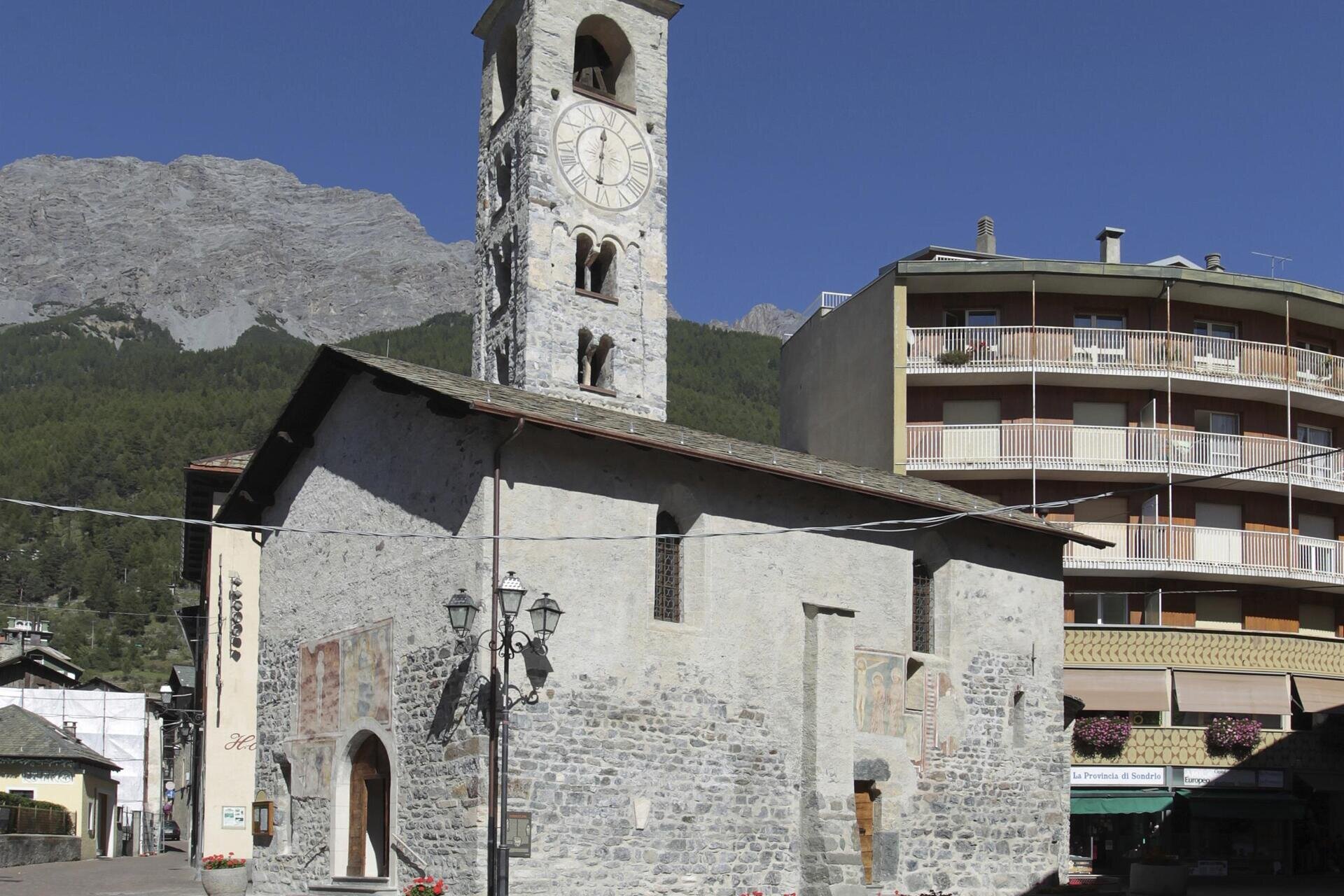
The Church of St. Vitalis is among the oldest in Bormio, as the earliest documents are traceable to 1196.
The architectural structure, simple and essential, still retains some elements of its Romanesque features and was certainly originally attached to a cemetery with ossuary.
Exterior
On the facade one can see interesting 14th and 15th-century frescoes. In the upper left part appears the so-called Christ of Sunday (14th century), a classic example of Biblia Pauperorum (Bible of the poor). Christ, bleeding and in a hieratic position, is depicted surrounded by plows, oven shovels, carts, and other tools, intending to remind the faithful to sanctify the holidays, recalling to them the prohibition of working on Sundays and feast days. To the right of Christ appears the Madonna on the throne with a holy monk and St. Anthony (Abbot). The fragments of two figures at the bottom, dating back to the late 14th century, could be St. Vitalis and his wife Valeria, parents of Saints Gervasius and Protasius, patrons of Bormio.
On the south side of the church, beside a protoromanic loophole, a Crucifixion from the late 14th century with Byzantine references is preserved. The external structure and the bell tower (16th century) have recently been restored, removing the plaster and leaving the original stone exposed.
Interior
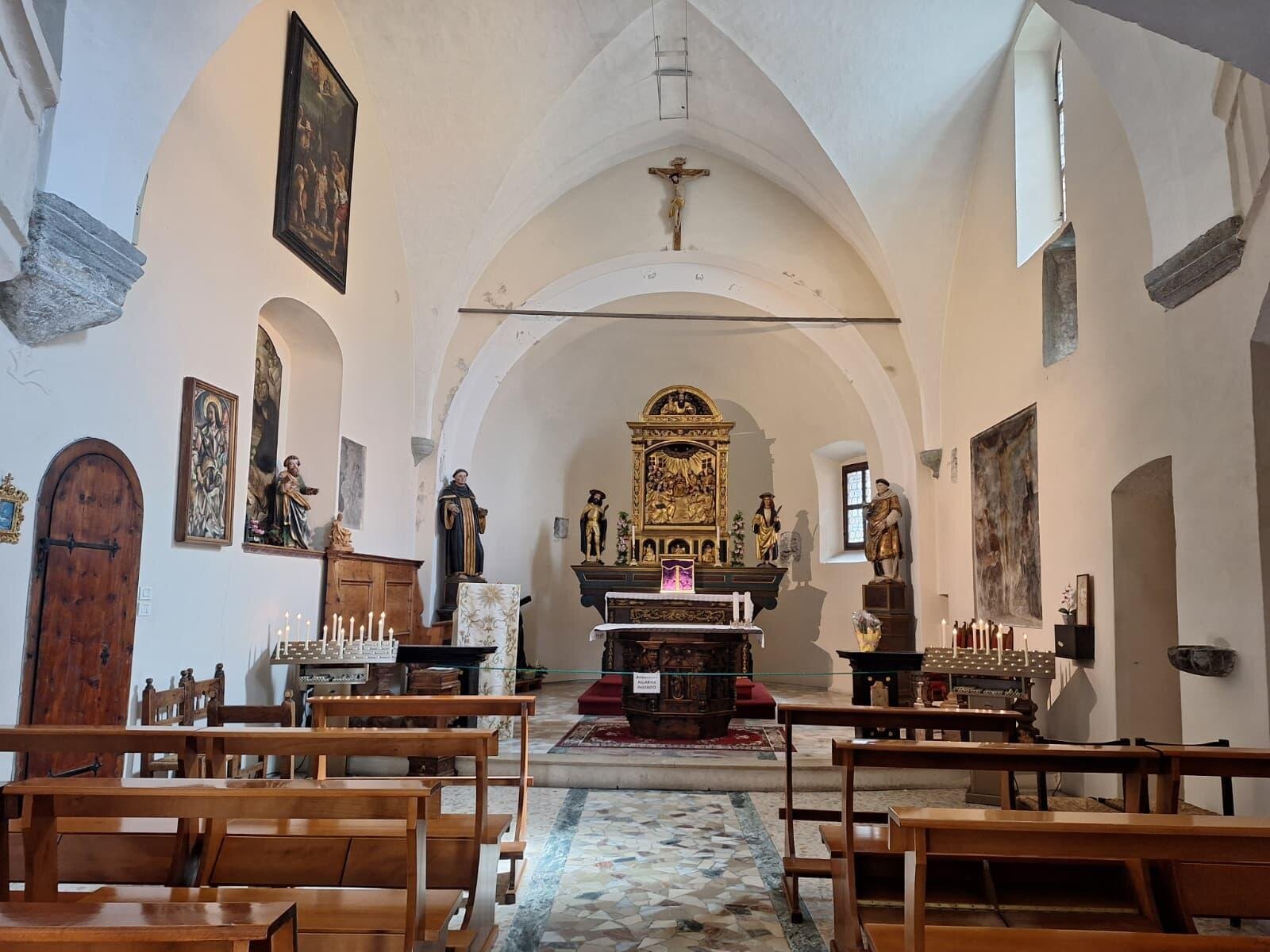
The structure has a single nave with ribbed vaults and the loggia can be reached by a small staircase. The furnishings are simple and austere, except for the gilded wooden altarpiece of the main altar which comes from the Church of St. Spirit and represents the Descent of the Holy Spirit upon the Apostles. On either side of the altarpiece, one can admire the statues of Saints Gervasius and Protasius, while two other statues, St. Lawrence and St. Dominic, come from the vanished Church of St. Lawrence. In the niche of the nave, there are two wooden statues of Apostles topped by the paintings of the Martyrdom of St. Stephen and the Death of St. Andrew Avellino. The Eucharistic table comes from a Paschal and was made by a local craftsman.
On the right side, one can observe two 16th-century frescoes depicting the Crucifixion with the Virgin, St. John, and St. Margaret with the dragon, while on the left side, we find the Madonna of milk.
In 1945, during some work near the church, a green stone bas-relief from Campello dating back to the 5th-2nd century B.C., was found, now preserved at the “Paolo Giovio” Civic Archaeological Museum of Como. This is probably a frieze dedicated to deities linked to the worship of the hot springs in the area. A plaster cast of the bas-relief is displayed at the Bormio Civic Museum.
 Visit the website
 +39 328 2272651
 parrocchia.bormio@gmail.com

