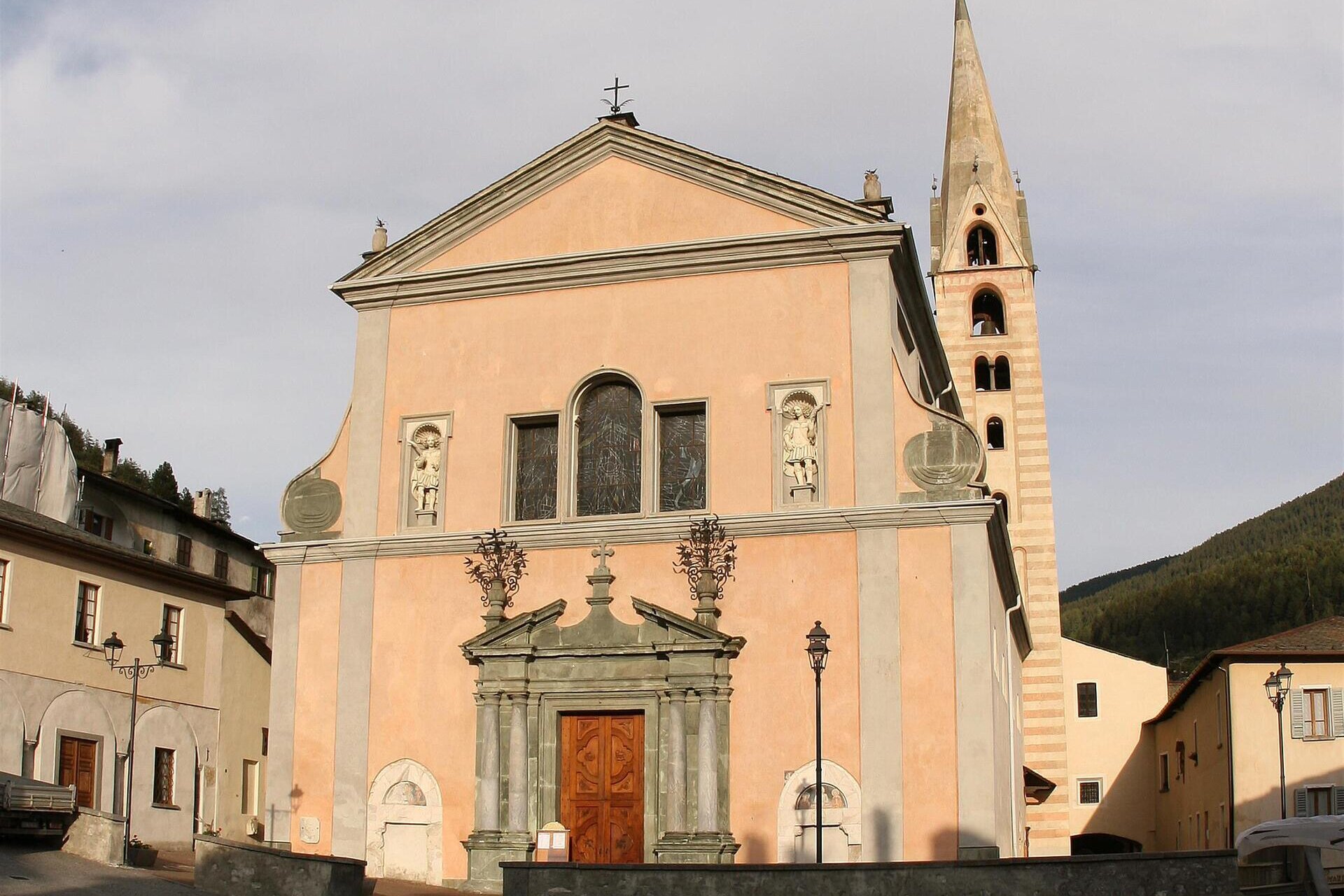
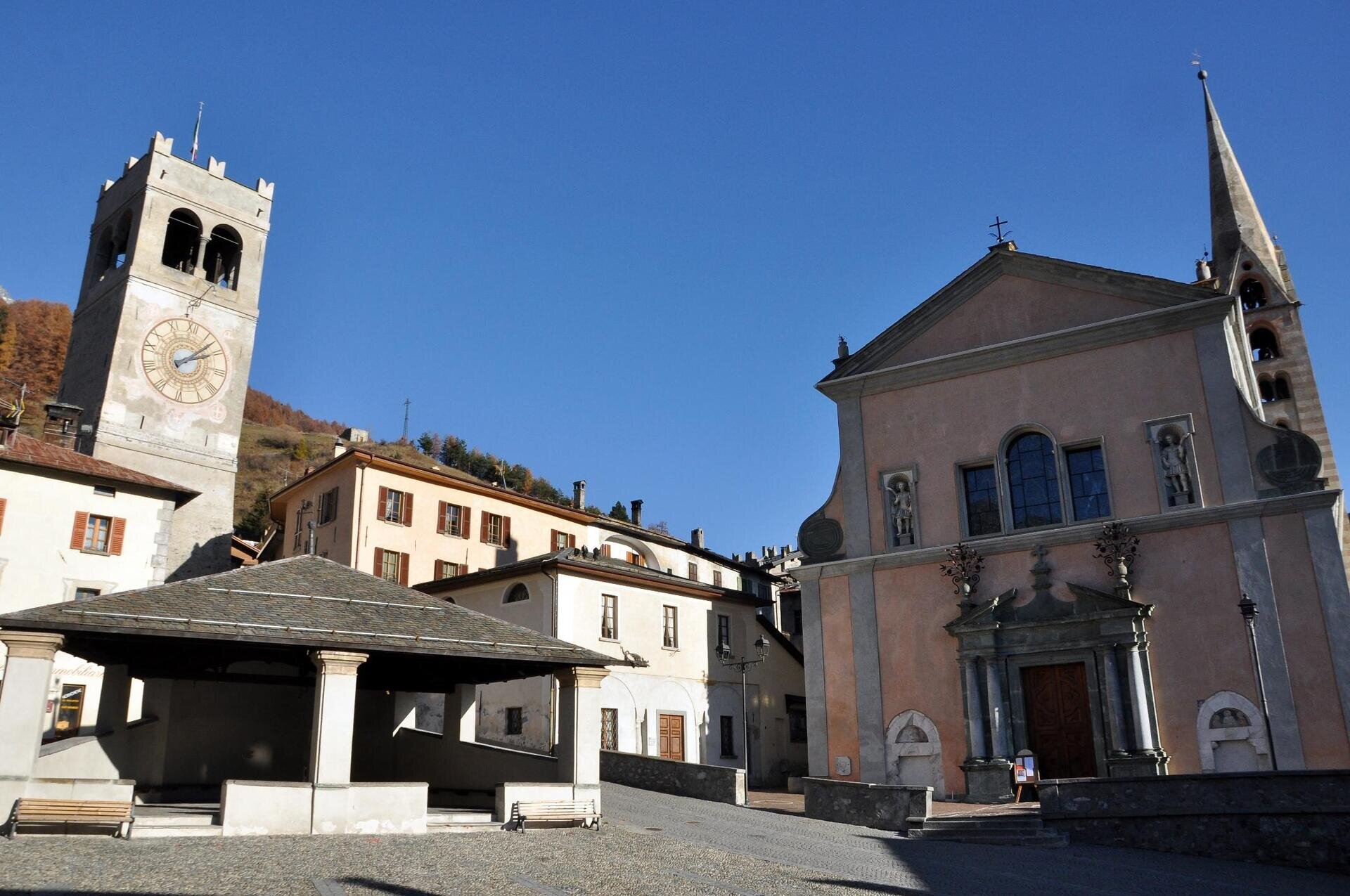
The Collegiate Church of Saints Gervasio and Protasio, patrons of Bormio, overlooks the main square of the town and is the oldest religious building present in Bormio, having been mentioned in a diploma from Emperor Lothair of 824 and recognized earlier as a parish.
Over time, the church has undergone numerous adaptations and renovations: the current single-nave structure with eight side chapels is based on the seventeenth-century rebuilding, necessitated by the destruction of the church by the Spaniards in 1621 during the religious wars that affected Valtellina. The original structure remains, except for the apse area.
Exterior
The facade features a beautiful seventeenth-century portal in local green stone overseen by two stucco statues of Saints Gervasio and Protasio, and two vases with natural elements. Notable are also the two thirteenth-century portals each surmounted by a fourteenth-century lunette with a fresco. The door and the stained glass of the facade date back to the 20th century.
On the steps, on the southern side of the church, there is a beautiful bricked-up portal and above the sacristy door, the fourteenth-century figure of St. Michael. The building next to the Collegiate, on the left, is the Column Hall, named after the sixteenth-century columns on the facade. This was likely the location of the ossuary, with the underground rooms serving as burial places.
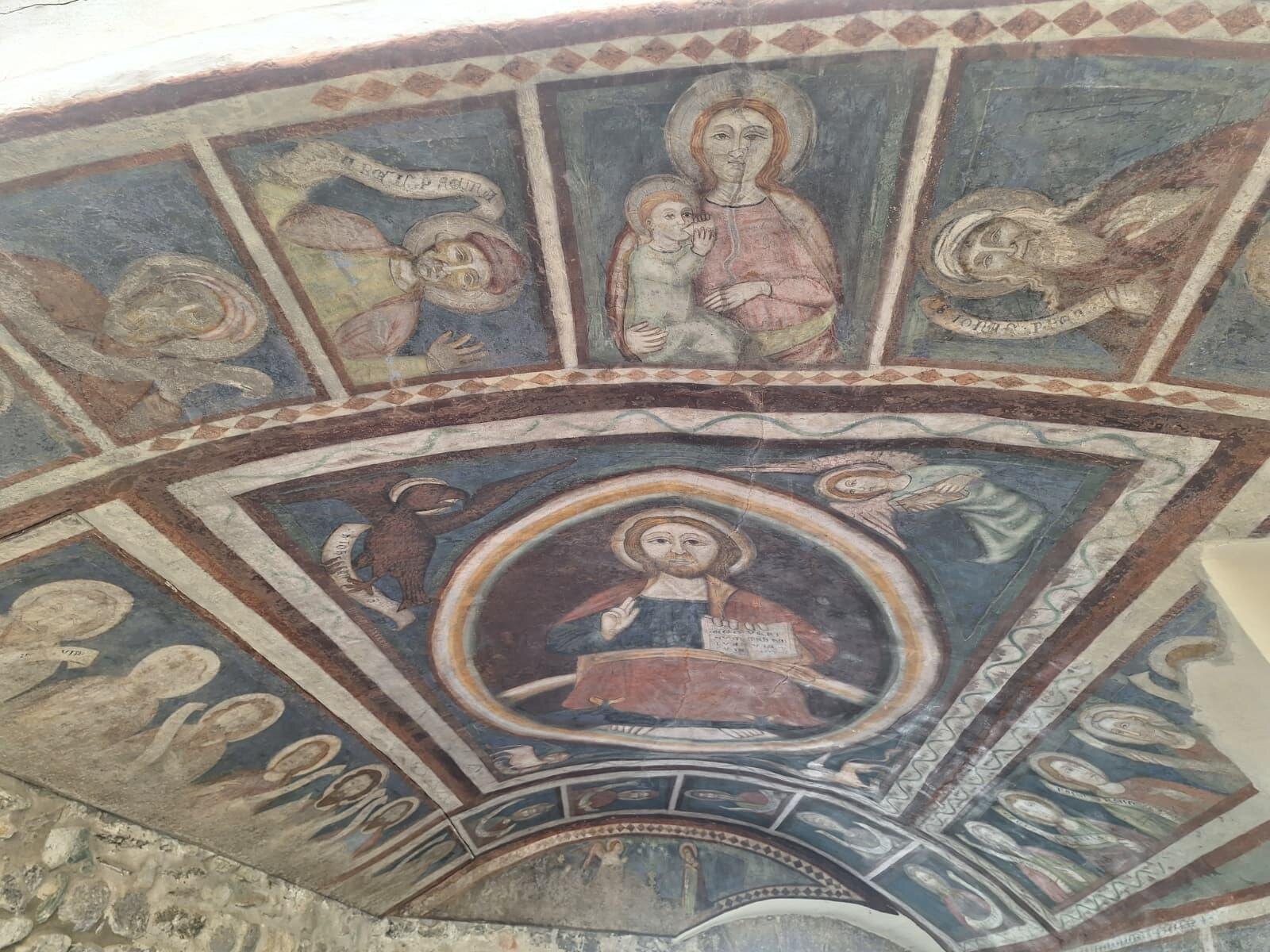
On the right outer side, there are the canons’ residence (severely damaged during a fire in 1855, losing its ancient and valuable decorations) and the parsonage. Noteworthy are the frescoes under the vault connecting this building with the church. Dated to 1393 and attributed to a Lombard master, the prominent figure is that of Christ Pantocrator whose facial features, frontal position, and disjointed feet are typical of Byzantine art. Christ is surrounded by the four Evangelists with their respective symbols. On the lateral walls of the vault, apostles, prophets, and also a Madonna of the Milk, besides an Annunciation and scenes from the life of Mary, are depicted.
Interior
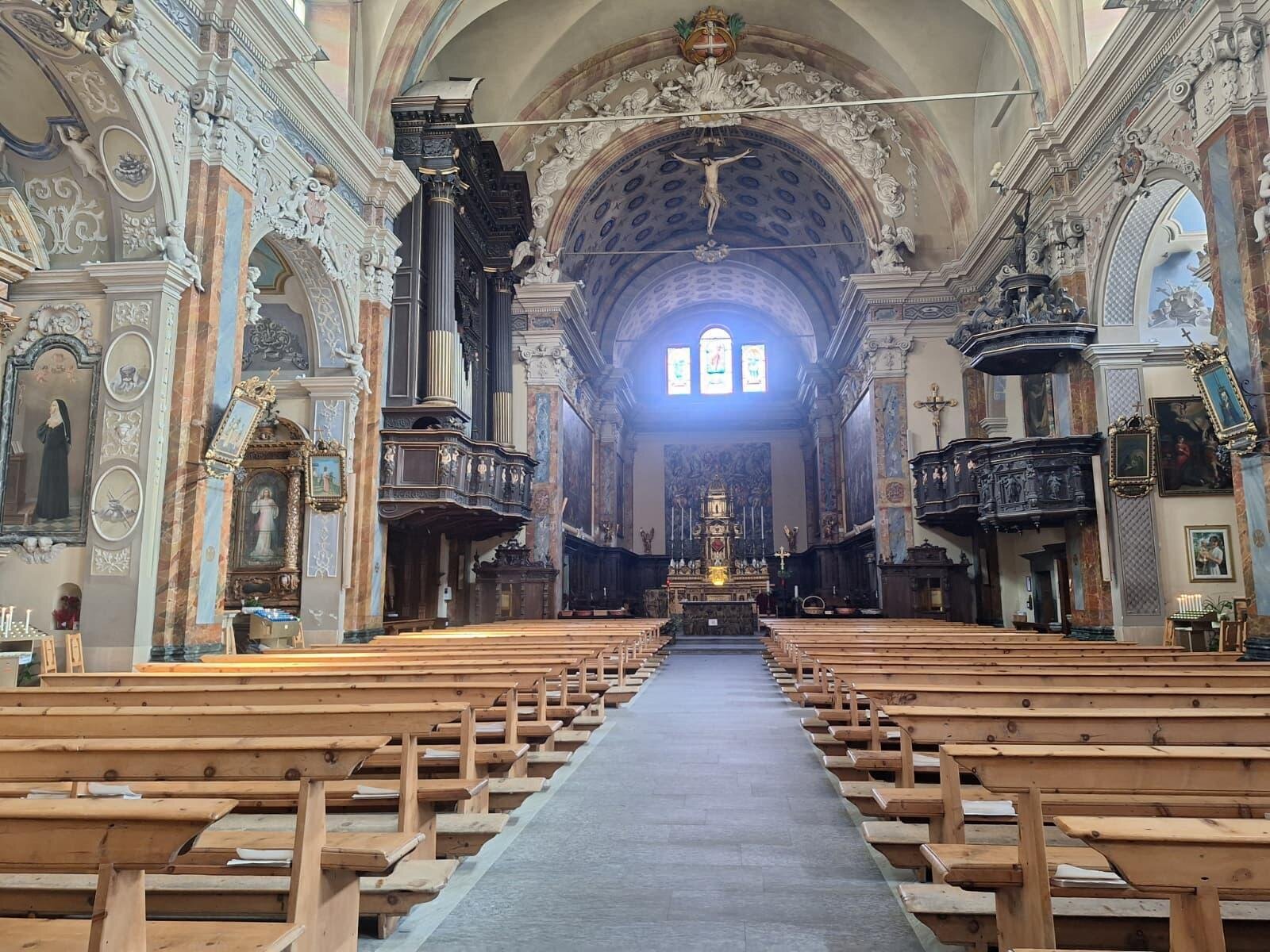
The interior features 8 chapels, 4 on each side, richly decorated. On the left side, in the first chapel, is housed the baptismal font, a white marble basin with an octagonal wooden temple topped with a dome (17th century).
The seventeenth-century organ is richly decorated with the figures of Saints Gervasio and Protasio, Barbara and Cecilia, and, at the top, the statue of God the Father. Once, during Lent, the organ was covered with a painted cloth, The Triumph of Music, which is now found on the back wall of the apse.
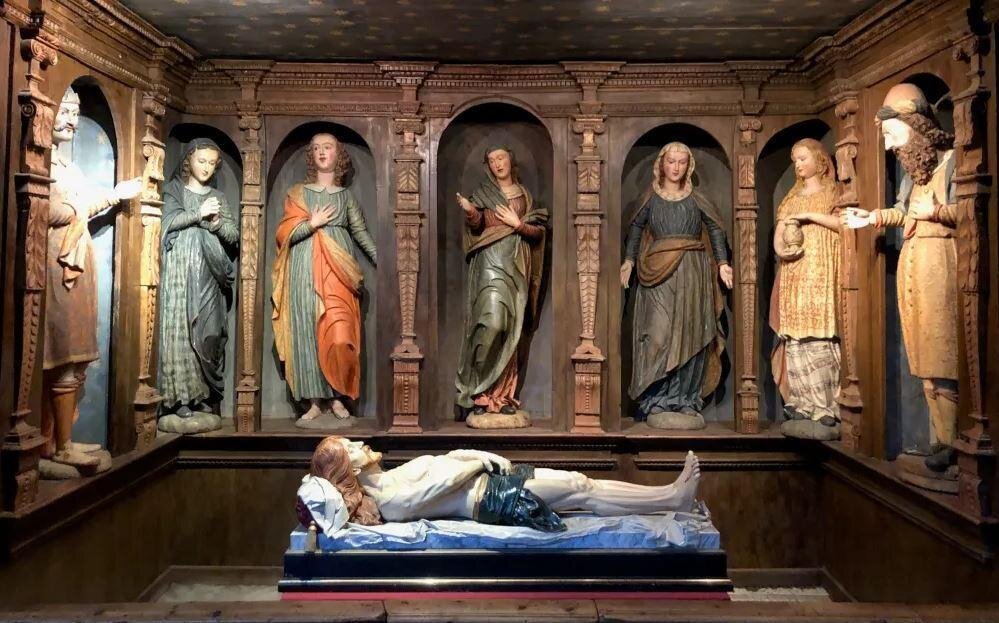
Under the majestic organ, particularly notable is the Lamentation with the seven life-sized wooden statues from the local school dated to the 17th century. Each has distinctive facial features representing the Madonna, Mary of Cleopas, Mary Salome, Mary Magdalene, St. John, Joseph of Arimathea, and Nicodemus. In the center, the Dead Christ, found in the parish of Frontale, in Sondalo, and returned to its original position. The presbytery area is very spacious with, in the center, the seventeenth-century wooden ciborium with the tabernacle in the shape of a temple. On the side walls, two large eighteenth-century canvases depicting, on the left, The Martyrdom of Saints Gervasio and Protasio and, on the right, The Transport of the Relics of Saints Gervasio and Protasio. At the back of the apse is displayed the large cloth of the Triumph of Liturgical Music (17th century), a complex work with many characters and iconographic references. On the side walls of the choir are two other paintings: on the right, The Virgin holding the dead child, Saints Sebastian, Stephen, and Agatha, and the coat of arms of the Municipality of Bormio (Nuvolone, 1629) and, on the left, The Coronation of the Virgin, the Baby Jesus, Saints Roch and Sebastian, and a saint bishop (Carlo Marni, 1640). In this work, one can sense how the town must have looked before the destruction of 1621.
In front of the organ, precious are the choir loft and the pulpit with rich wooden decoration.
 Visit the website
 +39 328 2272651
 parrocchia.bormio@gmail.com

