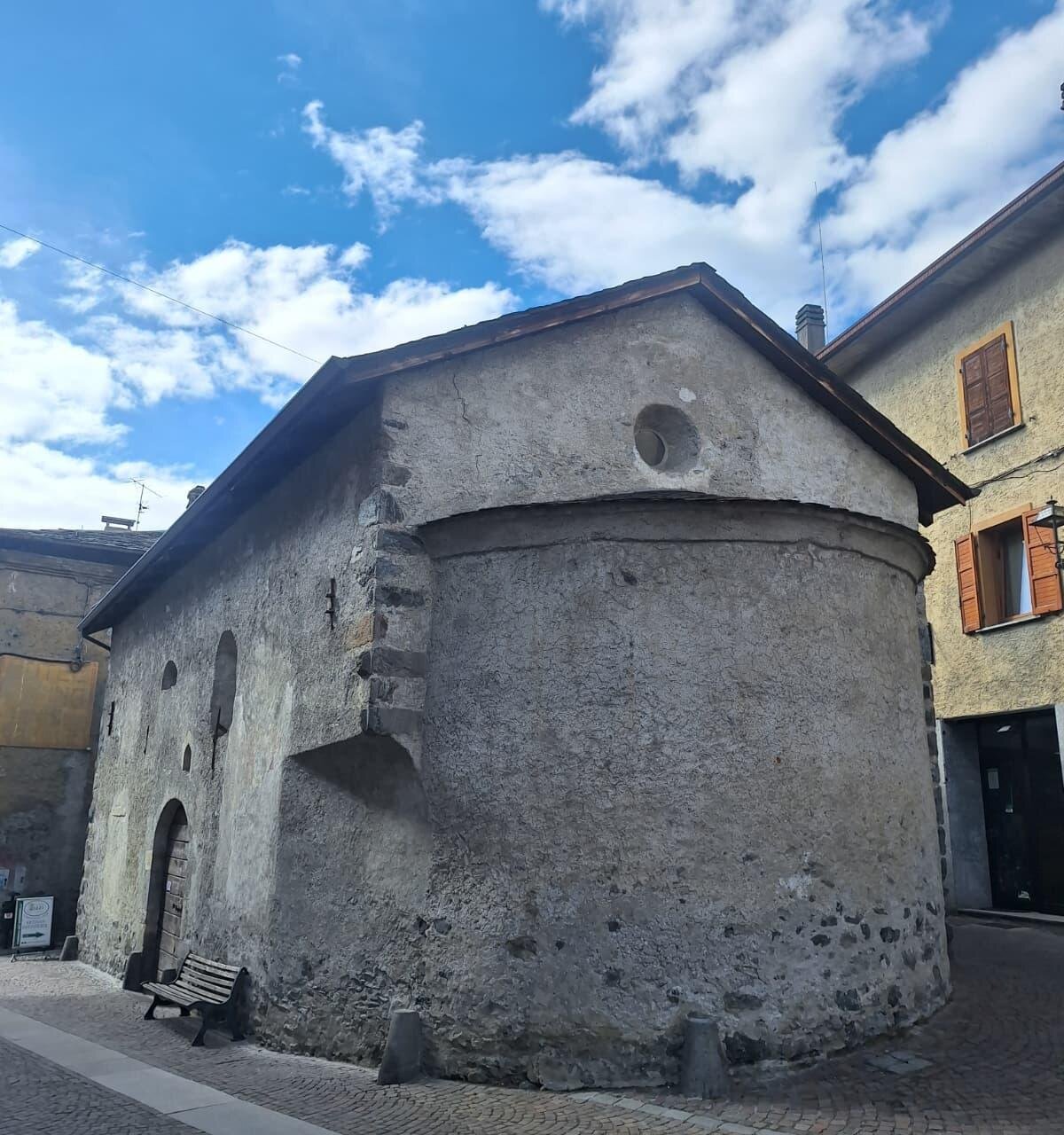
The Church of S. Spirito definitely predates the 16th century. It is mentioned in the Liber Stratarum of 1304, a sort of preliminary urban plan, but it is plausible that its construction predates that date.
Consecrated in 1797, it was used as a storage space and later as a residence. Acquired by the Municipality of Bormio in 1996, it was restored and reopened to the public.
Exterior
The structure has a rather simple and modest architecture, with a trapezoidal plan and a small circular apse. The external facade still shows traces of some frescoes, barely perceptible.
Interior
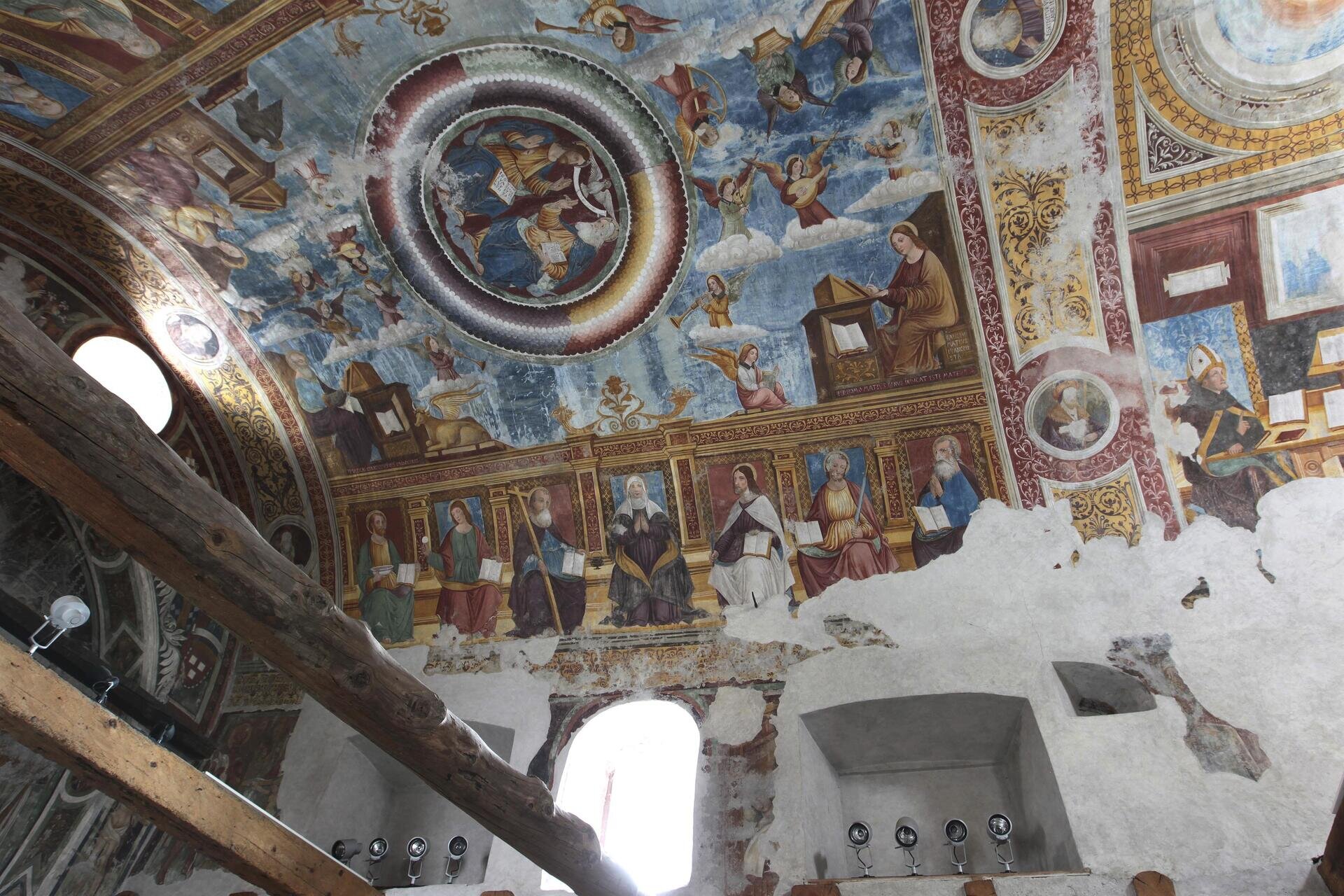
Entering the small church, one is left in awe by the rich pictorial decoration, thanks to the beautiful 15th-16th century frescoes preserved inside and enhanced by recent restoration work. A recurring theme is that of the Trinity and the Holy Spirit.
In the presbytery, frescoed in 1475 by Luigi Sermondi on commission from Giacomo Alberti (who appears kneeling in Renaissance clothing), the Annunciation and the Coronation of the Virgin by the Trinity are depicted from top to bottom.
In the lower part, the Throne of Grace stands out and, on the sides, the Adoration of the Magi, St. Christopher, and the Imago Pietatis (the image of Christ standing in the tomb).
In the triumphal arch, also by Sermondi, one can admire the faces of the Apostles and the Trinity Trifronte, corresponding to the keystone of the arch. The apse is completed by the presence of Musical Angels and, next to the Annunciation, there is a turreted landscape, probably identifiable with the 32 towers that Bormio had in the past.
The walls, according to ancient custom, were divided into various sections to allow each devotee to have a part of the sacred building painted at their own expense and to their own liking. For this reason, the images are sometimes heterogeneous or repetitive.
Some frescoes feature scratched inscriptions, some of which are curious.
On the right wall one can recognize St. Apollonia (holding pincers, patroness of dentists), St. John the Baptist, and higher up, St. Bartholomew (with the skin draped over his shoulder), along with a fragment of the Throne of Grace.
On the left wall, there is a barely discernible mention of St. Peter Martyr, the barely indicated St. Simonino (the child martyr believed to be a victim of a ritual killing), St. Christopher, and a holy bishop. Poorly visible is the Madonna on the Throne with a crowned saint. Higher up, St. John and St. Martha, the Madonna della Misericordia protecting under her mantle a group of Disciples in white tunics with hoods, St. Ursula, and some Renaissance figures. Even higher, within a rough reddish-brown band, St. Sebastian, St. Roch, the Martyrdom of St. Bartholomew, and the mystical marriage of St. Catherine. On the right, Saints Gervasius and Protasius. In the decoration of the arch, in addition to St. Bernardino, St. Anthony the Abbot, and the patron of the work, the coat of arms of the Quadrio family appears opposite that of the Alberti family.
The ceiling was frescoed in 1528 by Gianandrea De Magistris from Como, who imparted a strong doctrinal purpose. One can admire the Trinity, in a medallion, the Apostles, the Virgin Mary, Mary Magdalene, the Evangelists, the Fathers of the Church, and the Prophets.
 +39 0342 912205

